- 3D Printing Services

- CNC Machining Services

- Vacuum Casting Services

- Surface Finishing Services


 English
 Español

How to Choose 3D Printing Services for Prototypes and Production
Content
- 1 3D Printing Services: The Short Answer on Choosing the Right Provider
- 2 Common Types of 3D Printing Services and Their Characteristics
- 3 How Industrial 3D Printing Services Work from File to Finished Part
- 4 Materials for Custom 3D Printing Services: Resin, Nylon and Metal
- 5 Applications and Selection Points for Industrial and Commercial 3D Printing Services
- 6 Detailed Comparison of 3D Printing Services, CNC Machining and Silicone Mold Replication
- 7 Post-Processing and Surface Finishing: Where Lead Time Really Goes
- 8 How to Evaluate a China 3D Printing Services Manufacturer or Supplier
- 9 Maintenance and Care for 3D Printed Parts
- 10 FAQ About 3D Printing Services
- 10.1 Q1: What are 3D printing services and who uses them?
- 10.2 Q2: Which 3D printing process suits functional prototypes?
- 10.3 Q3: How accurate are industrial 3D printing services?
- 10.4 Q4: Can a 3D printing services manufacturer handle large parts?
- 10.5 Q5: How long do 3D printing services usually take?
- 10.6 Q6: How do I choose between 3D printing, CNC machining and silicone mold replication?
3D Printing Services: The Short Answer on Choosing the Right Provider
The right provider of 3D printing services is the one whose process, materials and finishing match what your part has to do, not the one with the longest machine list. In practice, most buyers choose among four proven routes: SLA or DLP resin for fine detail and smooth surfaces, SLS nylon for functional parts, SLM metal for strong or heat-exposed parts, and FDM plastic for large, early-stage models. Getting that match right at the start saves more time than any negotiation later on.
Here is a situation we see often. An engineering team has a housing design that will go to injection molding in three months. They need ten parts that look like the final product for a trade show, and twenty more that can survive a drop test and a few weeks of field handling. Those are two different jobs. Sending both to the same machine usually compromises either appearance or strength, while good 3D printing services split the work: resin and paint for the show samples, nylon for the drop test.
The same logic applies when you search for a China 3D printing services manufacturer or supplier. A capable partner does not simply accept your file and press print. They check wall thickness, ask where the part will be used, suggest a more suitable material, and tell you in advance which surfaces will need machining or painting. That conversation is a stronger signal of quality than any equipment list.
This guide is written for product designers, engineers and sourcing teams who order prototypes, jigs, small batches and end-use parts. It covers the following topics:
- The main types of custom 3D printing service and what each one does well
- How a job moves from a digital file to a finished part
- How to choose between resin, nylon and metal materials
- When CNC machining or silicone mold replication is the better fit
- How to compare a commercial 3D printing services supplier on the points that matter
- How to care for printed parts after delivery
Start with what the part must do, then choose the process; reversing that order is the most common cause of rework.
Common Types of 3D Printing Services and Their Characteristics
ISO/ASTM 52900, the standard that defines additive manufacturing terms, groups the technology into seven process families. Commercial 3D printing services mostly build their offer on three of them: vat photopolymerization (SLA and DLP), powder bed fusion (SLS and SLM) and material extrusion (FDM). Scroll through the cards below to see how each one behaves in real projects.
-
SLA resin
A UV laser cures liquid resin layer by layer. It is strong on fine features, sharp edges and smooth surfaces.
Typical uses: appearance models, master patterns, clear parts and small housings.
Watch for: brittleness in some resins and slow yellowing under long UV exposure.
-
DLP resin
A projector cures a whole layer at once, so build time stays steady even with many small parts on one plate.
Typical uses: small detailed parts, connectors, miniature components and pattern batches.
Watch for: a smaller build area than many laser-based machines.
-
SLS nylon
A laser sinters nylon powder. The surrounding powder supports the part, so complex shapes and moving assemblies are practical.
Typical uses: snap fits, housings, ducts, functional prototypes and short-run end-use parts.
Watch for: a grainy surface unless the part is dyed, blasted or smoothed.
-
SLM metal
A laser fully melts metal powder in a protective atmosphere, producing dense parts in aluminium, stainless steel and titanium alloys.
Typical uses: brackets, manifolds, lightweight structures and heat-exposed components.
Watch for: supports, residual stress and the need to machine critical faces.
-
FDM plastic
A heated nozzle lays down thermoplastic filament. It suits large parts and early-stage models.
Typical uses: fixtures, large mockups and simple enclosures.
Watch for: visible layer lines and lower strength between layers.
Quick reference table
| Process | Typical materials | Best fit | Main limitation |
|---|---|---|---|
| SLA | Standard, tough, clear and high-temperature resins | Appearance models and fine detail | Some resins are brittle; UV aging over time |
| DLP | Photopolymer resins | Small detailed parts in batches | Smaller build area |
| SLS | PA12 nylon and filled nylons | Functional parts, complex geometry | Grainy as-built surface |
| SLM | AlSi10Mg aluminium, 316L stainless steel, titanium alloy | Strong, light, heat-resistant parts | Supports, stress relief, finishing work |
| FDM | ABS, PETG, PC and similar thermoplastics | Large models and fixtures | Layer lines, directional strength |
Many buyers ask for a single custom 3D printing service and expect one answer. In reality, an experienced 3D printing service provider often combines routes inside one project. A lighting enclosure might be printed in SLA resin for the visible shell, in SLS nylon for the internal bracket, and later reproduced in small batches through silicone molds once the design is frozen. Thinking in routes rather than in a single machine gives you more options and fewer surprises.
The chart below compares the five routes on five qualities that buyers raise most often. Darker cells mean a stronger result relative to the other four routes, so read it as a ranking rather than a measurement.
The heat map shows why no single process wins every category. SLA and DLP lead on detail and surface finish, which is why they are the usual starting point for appearance models and master patterns that will later be painted or copied in silicone. SLS nylon and SLM metal lead on strength, and SLM adds the highest heat resistance, which matters for brackets and components near motors or exhaust paths.
FDM ranks highest on build size, so it remains useful for large fixtures and early mockups where surface quality is secondary. For a manufacturer that offers resin, nylon and metal printing together with machining and painting, this kind of table becomes a practical routing guide: each part is sent to the process that fits its main requirement, and the remaining gaps are closed with finishing. If your part needs two or three of these qualities at once, expect a combined route rather than a single printer.
Each process is strongest in a different area, so match the one that covers your primary requirement and close the rest with finishing.
How Industrial 3D Printing Services Work from File to Finished Part
Understanding the workflow helps you predict where delays and quality issues come from. Most industrial 3D printing services follow the same six steps, even though the machines differ.
- File review. The engineer checks your STEP, STL or similar 3D model for thin walls, closed cavities, missing faces and units. A good review flags problems before printing, not after.
- Process and orientation choice. The part is assigned a process and a build orientation. Orientation affects surface quality, strength direction, the number of supports and the print time.
- Printing. The machine builds the part layer by layer. Layer thickness commonly ranges from roughly 0.025 mm on fine resin machines to 0.2 mm or more on FDM equipment.
- Cleaning and support removal. Resin parts are washed and UV post-cured. Nylon parts are depowdered. Metal parts are heat treated if needed and cut from the build plate, and supports are removed.
- Post-processing and finishing. Sanding, blasting, dyeing, priming, painting, tapping threads or machining critical faces are added according to the drawing.
- Inspection and packing. Key dimensions are checked, surfaces are inspected, and parts are packed so fine features are not damaged in transit.
Notice that printing itself is only one step. Buyers who judge a supplier only by printer count often overlook how much of the final quality comes from steps four and five. We come back to this in the post-processing section.
Design details that change the result
Small design decisions often decide whether a printed part works. The table below lists starting guidance that many service providers use when reviewing files. Exact limits depend on the machine, the material and the part size, so treat these as conversation starters rather than fixed rules.
| Design feature | Resin (SLA, DLP) | Nylon (SLS) | Metal (SLM) | Plastic (FDM) |
|---|---|---|---|---|
| Minimum wall thickness | About 0.6 to 1.0 mm | About 0.8 to 1.0 mm | About 0.5 to 1.0 mm | About 1.0 to 1.5 mm |
| Supports | Needed for overhangs, may leave contact marks | Not needed, powder supports the part | Needed for overhangs and heat control | Needed for steep overhangs |
| Trapped material | Add drain holes for liquid resin | Add escape holes for loose powder | Add escape holes for loose powder | Rarely an issue |
| Threads and tight bores | Tap or add inserts after printing | Tap or add inserts after printing | Machine after printing | Use inserts for repeated assembly |
Two habits save the most trouble. First, mark which faces are functional, such as bearing seats, sealing surfaces and mating faces, so the provider can plan machining or reaming on those faces only. Second, avoid designing fully enclosed cavities unless you add holes for removing powder or resin; a hollow part that cannot be emptied will either be rejected or arrive heavier and weaker than intended.
Printing is one step in a six-step chain, and design choices made before the first layer decide most of what happens after it.
Materials for Custom 3D Printing Services: Resin, Nylon and Metal
Material choice drives strength, appearance, heat tolerance and how the part ages. A custom 3D printing service should be able to explain why it recommends one material over another in plain terms, linked to your use case. The two columns below split the options into polymers and metals.
Polymers: resin, nylon and plastic
|
Metals for SLM printing
|
Material selection at a glance
| Material | Typical use | Strength | Limitation |
|---|---|---|---|
| Tough resin | Display models, form and fit checks | Fine detail, smooth surface | Can become brittle with age or UV |
| PA12 nylon | Snap fits, housings, ducts | Durable, good fatigue behavior | Absorbs moisture slowly |
| AlSi10Mg aluminium | Light brackets, heat sinks | Low weight, thermal conductivity | Needs stress relief, finishing |
| 316L stainless steel | Fluid parts, corrosion-exposed parts | Corrosion resistance, toughness | Heavier, slower to finish |
| Titanium alloy | Lightweight structural parts | Strength-to-weight ratio | Demanding process, longer lead time |
Questions to settle before you pick a material
- What is the highest temperature the part will see, and for how long?
- Will it carry load once, repeatedly, or only hold its shape?
- Will it meet oils, cleaning agents, water or outdoor light?
- Does it need to look like a finished product, or just fit and function?
- How many pieces will you need now, and how many later?
Answering these five questions in your inquiry usually shortens the quoting loop by a full round of emails, because the engineer can recommend a material without guessing.
Temperature, load, environment and appearance are the four facts that decide the material; share them in your first message.
Applications and Selection Points for Industrial and Commercial 3D Printing Services
Industrial 3D printing services appear in nearly every manufacturing sector, but the reasons people use them are surprisingly consistent: they need a physical part faster than tooling allows, or they need a shape that other methods struggle to make. The two columns below connect typical scenarios with the points that matter when choosing a supplier for each.
Common application scenarios
|
Selection points to check
|
Large scale 3D printing services
When buyers search for large scale 3D printing services, they usually mean one of two things: a single part that exceeds the build volume of standard machines, or many medium parts needed in one batch. The first case is typically solved by splitting the model into sections with alignment features such as keys or pins, printing the sections, then bonding and finishing the seams so the joint disappears under paint. The second case is solved by nesting parts efficiently and by choosing a process, such as SLS nylon, where many parts share one build.
Ask a potential supplier how they handle seams and flatness on split parts. A clear answer, ideally with a sample photo, tells you far more than a stated maximum dimension.
Small batches and bridge production
Another growing use is bridge production, where printed or cast parts fill the gap between prototype and mass production. If your injection mold will take eight to twelve weeks to build, a commercial 3D printing services supplier can keep your pilot line, field trials or early customer orders moving. For appearance parts, silicone mold replication often takes over once a master pattern is approved, because a single mold can produce a small batch of consistent copies. Choosing a supplier that offers both printing and replication avoids transferring files and drawings between companies.
Choose a supplier by how well it supports your next step, not only the current prototype.
Detailed Comparison of 3D Printing Services, CNC Machining and Silicone Mold Replication
Many projects do not need 3D printing at all, and an honest supplier will tell you so. The table compares the three most common routes for prototypes and small batches so you can see where each one fits.
| Factor | 3D printing | CNC machining | Silicone mold replication |
|---|---|---|---|
| Typical quantity | One to a few dozen | One to several hundred | Roughly 10 to 50 copies, depending on mold life |
| Geometry freedom | Very high, internal channels and lattices possible | Limited by tool access | Follows the master pattern |
| Material choice | Resins, nylon, metal powders, thermoplastics | Wide range of solid metals and plastics | Polyurethane resins that imitate common plastics and rubbers |
| Surface as produced | Layer lines or grain until finished | Tool marks, easy to refine | Smooth, copies the master surface |
| Tolerance | Moderate, process dependent | Tight on machined features | Moderate, shrinkage must be considered |
| Start-up time | Fast, no tooling | Fast, fixturing needed | Master and mold needed first |
| Best for | Complex shapes, early iterations | Tight tolerance, strength, metal parts | Look-alike small batches |
Accuracy is the factor buyers ask about most, and it is also the one most often misunderstood. The next chart shows indicative working tolerances for each printing route. Please read it as a planning aid, because actual results depend on part size, geometry, orientation and machine calibration.
The chart shows that resin routes sit at the tight end for small features, which is why they are chosen for connectors, fine housings and patterns where fit matters. SLM metal falls in a similar band for small parts, but the numbers apply to as-printed features, and critical bores or mating faces are normally machined afterward to reach tighter limits.
SLS nylon and FDM show wider values because powder shrinkage, thermal behavior and layer deposition all add variation, especially on long or thin parts. For a supplier that also operates CNC machining, this difference is easy to manage: the printed body provides the geometry, and a short machining operation finishes the few features that need tighter control. When you send a drawing, mark which dimensions are critical and which are only reference, since this lets the engineer apply effort where it counts.
Overall, the practical rule is simple. Use printing when shape complexity or speed is the main constraint, machining when tolerance or material is, and silicone replication when you need several look-alike parts from one approved master.
Print for shape, machine for tolerance, replicate for small batches, and combine them when one part needs more than one strength.
Post-Processing and Surface Finishing: Where Lead Time Really Goes
New buyers are often surprised that a part printed overnight can take several days to deliver. The reason is that finishing, not printing, tends to take the largest share of the schedule for appearance parts. Understanding this early lets you plan realistic milestones and avoid last-minute pressure.
Typical finishing routes by process
- Resin parts: support removal, sanding, filler where needed, primer, color painting and clear coat. Parts that must be transparent are polished and coated rather than painted.
- Nylon parts: bead blasting for a uniform matte texture, dyeing for consistent color, and vapor or tumble smoothing when a more even surface is needed.
- Metal parts: stress relief, removal from the build plate, support removal, machining of critical faces, blasting or polishing, and optional anodizing or passivation.
- FDM parts: sanding, filling and painting for appearance, or acetone-free smoothing methods suited to the material.
The chart below shows an indicative split of lead time for three typical projects. Each bar adds up to one hundred percent of the schedule for that project type, and the figures illustrate common patterns rather than fixed rules.
The resin visual prototype spends the largest share of its schedule in finishing, because sanding, priming and painting must be done in stages with drying time between them. Printing itself is a modest portion, even though many buyers assume it dominates.
The functional nylon part flips the picture: printing and depowdering take a larger share, while finishing is lighter because a blasted or dyed surface is often acceptable. For the metal bracket, cleaning and post-processing, which includes stress relief, plate removal and support removal, become the biggest block, and a short finishing step follows.
This is why a supplier with painting and machining under one roof has a practical advantage for mixed projects. Fewer handoffs reduce the waiting time between steps, and the same team can see how a finishing decision affects dimensions. If your schedule is tight, ask the supplier which stage is likely to be the longest for your specific part, then decide whether a simpler finish would meet your need.
Plan finishing into the design
Painting adds a coating layer, often a few hundredths of a millimeter per coat, which matters for snap fits and tight assemblies. Tell the supplier early whether a mating surface will be painted, so the model can be adjusted or that surface can be masked. The same applies to anodizing on aluminium, where the coating grows slightly on each face and can affect small holes and threads.
Finishing, not printing, often sets the delivery date for appearance parts, so decide the surface requirement before you place the order.
How to Evaluate a China 3D Printing Services Manufacturer or Supplier
Sourcing from a China 3D printing services manufacturer gives access to wide material choice, mature finishing skills and responsive turnaround, but quality and communication still vary between suppliers. The steps below turn a vague search for 3D printing service providers into a structured comparison.
What to send with an inquiry
- A 3D model in STEP or STL format, with units stated
- A 2D drawing that marks critical dimensions, threads and mating faces
- Quantity now and expected quantity later
- Material preference or the performance you need, such as temperature and load
- Surface requirement, such as raw, blasted, painted or polished
- Target delivery date and destination
What a capable supplier does in return
- Replies with specific questions about function, not only a request for the file
- Points out design risks, such as thin walls or trapped powder, before production
- Explains what is achievable as printed and what needs machining
- Sends progress photos and inspection results for critical features
- Packs fine and painted parts with protection suited to international shipping
One example of this one-stop approach is Zhejiang Jiaheng Intelligent Equipment Manufacturing Co., Ltd., an OEM and ODM 3D printing services supplier. Its design team turns client ideas into practical product designs, and the factory prints in resin, nylon and metal, backed by advanced machining. Silicone mold replication supports precise small-batch production, and surface treatments such as painting improve the final appearance. Keeping design, printing, replication and finishing on one platform means the same team follows a project from concept to delivered part, which reduces handoffs and saves time.
Many buyers also use a simple scorecard to compare suppliers. The chart below shows an example weighting that buyers can adapt, based on typical procurement priorities for prototype and small-batch work rather than any industry statistic. Treat the percentages as a starting point and shift them according to what your project needs most.
Process and material fit receives the largest share because a supplier that lacks the right technology cannot make up for it with speed or service. Quality control and lead time with communication follow at equal weight, since a late or uncertain delivery can be as damaging to a development schedule as a dimensional error.
Post-processing carries more weight than many first-time buyers expect, which links back to the lead-time chart: finishing capability affects both appearance and delivery date. Engineering feedback gets a smaller but meaningful share, and it is often the best predictor of how smooth the project will be, because a supplier that asks good questions early usually avoids rework later.
You can adjust these weights for your own case. A team ordering a single metal part might raise inspection, while a team preparing a trade show sample might raise finishing and communication. Whatever the weights, scoring two or three suppliers on the same sheet makes the comparison more objective and easier to explain to colleagues.
Start with a sample order
If you are working with a new supplier, a small sample order is the most reliable test. Choose a part that includes the features you care about, such as thin walls, a tight bore and a painted surface, and judge the result on dimensional accuracy, surface quality, packing and how clearly the supplier communicated. A single sample teaches you more about a partner than any brochure.
Judge a supplier by the questions it asks and the finishing it controls, then confirm with a small sample order.
Maintenance and Care for 3D Printed Parts
Printed parts need less care than many people expect, but the right habits extend their working life, especially for resin and nylon. The table summarizes the main points by material.
| Material | Recommended care | Avoid |
|---|---|---|
| Resin | Wipe with a soft cloth, store away from direct sunlight, keep painted surfaces free from solvents | Long outdoor exposure, sudden impact in cold conditions |
| Nylon | Clean with mild soap and water, dry thoroughly, store in a dry place | Prolonged damp storage, which can change stiffness and size slightly |
| Aluminium | Keep dry, wipe off residues, protect machined faces with a thin film of oil if stored long | Contact with salt or strong alkaline cleaners |
| Stainless steel | Rinse after exposure to chemicals, clean with non-abrasive pads | Steel wool, which can leave particles that cause rust spots |
| FDM plastic | Keep away from heat sources, clean with a damp cloth | Loads that pull layers apart, and storage near hot surfaces |
A few extra habits help. Inspect snap fits and threaded inserts periodically, since repeated assembly wears them first. If a fixture or jig is used daily, keep a spare or a second revision so production does not stop when a part wears out. For painted parts, touch up chips early to stop moisture from creeping under the coating. Finally, record the material and print date on your drawing archive, so a repeat order can match the original exactly.
Keep printed parts dry, clean and away from heat and strong sunlight, and keep a spare for anything used every day.
FAQ About 3D Printing Services
Q1: What are 3D printing services and who uses them?3D printing services are manufacturing services in which a supplier builds parts from your digital model using additive processes such as SLA, SLS, SLM and FDM, then finishes and inspects them. Product designers, equipment makers, automotive and electronics teams and sourcing departments use them for prototypes, fixtures, small batches and parts with complex shapes. Because no tooling is needed, you can move from file to part in days rather than weeks. |
Q2: Which 3D printing process suits functional prototypes?SLS nylon is a common choice for functional prototypes because it offers durable, slightly flexible parts and needs no support structures, which allows snap fits and moving assemblies. For parts that face heat or higher loads, SLM metal is often considered. If the prototype must also look like a finished product, a supplier may print the functional version in nylon and the visual version in resin. |
Q3: How accurate are industrial 3D printing services?Accuracy depends on process, part size, geometry and orientation. Resin processes are generally the most precise for small features, while nylon and FDM show wider variation. For tight limits on bores, threads or mating faces, suppliers usually print with a small allowance and finish those features by machining or reaming. Marking critical dimensions on your drawing helps the engineer plan this correctly. |
Q4: Can a 3D printing services manufacturer handle large parts?Yes, in most cases. Parts larger than a single build volume are usually divided into sections with alignment features, printed, bonded and finished so the seams are hidden. Large quantities of medium parts can be nested together in one build. Ask the supplier for photos of similar split or large parts, and confirm how they control flatness and seam quality. |
Q5: How long do 3D printing services usually take?Simple resin or nylon parts can often be ready within a few working days, while painted appearance parts and metal parts take longer because of finishing and heat treatment. The schedule depends on part size, quantity, material and surface requirement. Ask your supplier which stage is likely to take longest for your part and whether a simpler finish could shorten it. |
Q6: How do I choose between 3D printing, CNC machining and silicone mold replication?Choose 3D printing when shape complexity or speed matters most, CNC machining when tight tolerance or a specific solid material is required, and silicone mold replication when you need several consistent look-alike parts from one approved master. Many projects use more than one route. A supplier that offers all three, together with painting and finishing, can recommend the combination that fits your drawing and quantity. |
related products
-
 PAHT+CF High-Temp Nylon Carbon Fiber Reinforced Material 3D Printing Service
-
 PPS+CF Carbon Fiber Reinforced Material 3D Printing Service
-
 Standard FDM Materials 3D Printing Service (PLA, PETG, ABS)
-
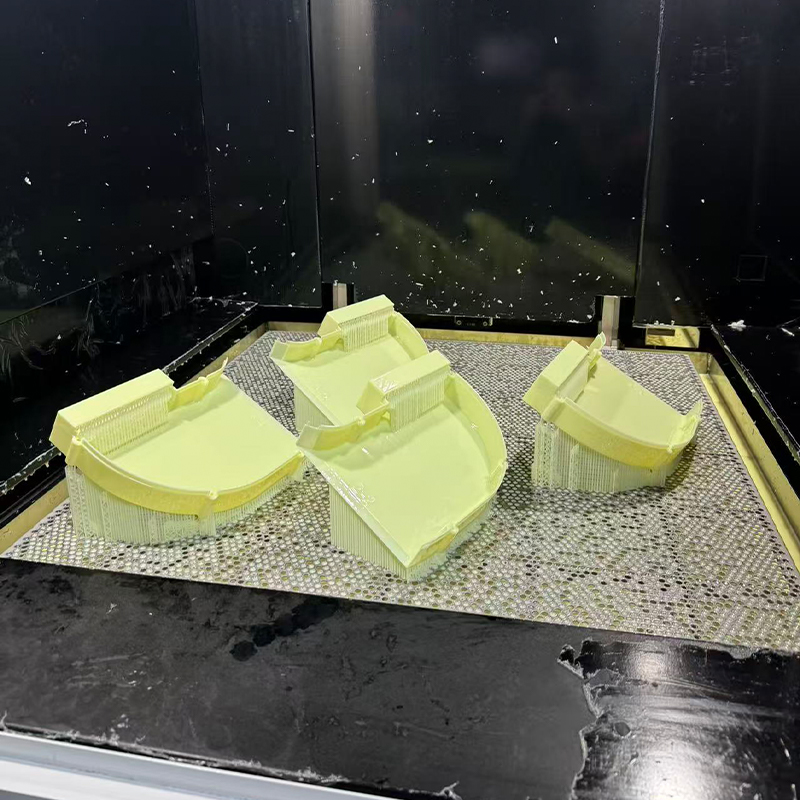 Yellow ABS-Like Resin 3D Printing Service
-
 Aluminum Alloy AlSi10Mg 3D Printing Service
-
 Decal & Silk Screen Printing
Contact Information
-

zjjh@jiahzn.cn
-

+86-18936159957
-
+86-18966326325
ADD
-

Building 7, No. 188, Hongni Section of Zha Wang Road, Danghu Subdistrict, Pinghu City, Jiaxing City, Zhejiang Province, China
Copyright © 2026 by Zhejiang Jiaheng Intelligent Equipment Manufacturing Co., Ltd. OEM/ODM Integrated Smart Manufacturing Platform Manufacturers
